The Financing Case for Renewable Energy in Zimbabwean Agriculture
A solar pump can work perfectly and still be a poor loan. If its repayments fall due before the crop is sold, or the equipment is financed in US dollars while the farm earns mainly in local currency, the technology has not solved the financing problem. It has only changed its form.
That distinction matters as Zimbabwe looks to renewable energy to support irrigation, cold storage and agricultural processing. The commercial opportunity is real. But the strongest projects will be financed because they create measurable operating cash flow, not simply because solar, biogas or mini-grids are technically suitable.
A large technical opportunity is not a bankable pipeline
The scale of the opportunity is easy to see. IRENA’s assessment of decentralised renewable energy in Zimbabwean agriculture identified major gaps in irrigation, storage and processing. Its reported findings show that 75% of surveyed farmers saw lack of irrigation pumps as their biggest productivity limitation, while 75% lacked proper storage. Some hot-season post-harvest losses were reported as high as 50%.
For solar irrigation kits, IRENA estimated an addressable market of US$7.1 billion under an upper scenario covering two million hectares. It also reported indicative payback periods of one to six years across commercially ready decentralised renewable-energy applications.
Those numbers are important, but they need careful interpretation. US$7.1 billion is not a list of funded projects or customers ready to borrow. The payback range is not a guaranteed investor return. Both depend on equipment cost, water, crop choice, utilisation, maintenance, selling prices and the terms of finance.
RE4Agri moved the discussion towards investability
The Renewable Energy for Agriculture conference, held in Harare from 7 to 9 September 2026, brought together agribusinesses, energy developers, policymakers and financiers. Sessions covered irrigation, biogas, aquaculture, agrivoltaics, mini-grids and embedded generation at agricultural and commercial sites.
The financing discussion exposed the real constraint. Public reporting from the conference described a shortage of investment-ready projects rather than a simple shortage of capital. Developers face long preparation periods, incomplete feasibility work, uncertain offtake, land and permitting questions, and limited early-stage funding.
Financiers also face a structural mismatch. Domestic deposits are often shorter than the life of energy assets. Much of the equipment requires foreign currency, while many agricultural users earn local-currency revenue. Without a credible way to allocate those risks, a technically attractive system may not reach financial close.
Where renewable energy can support repayment
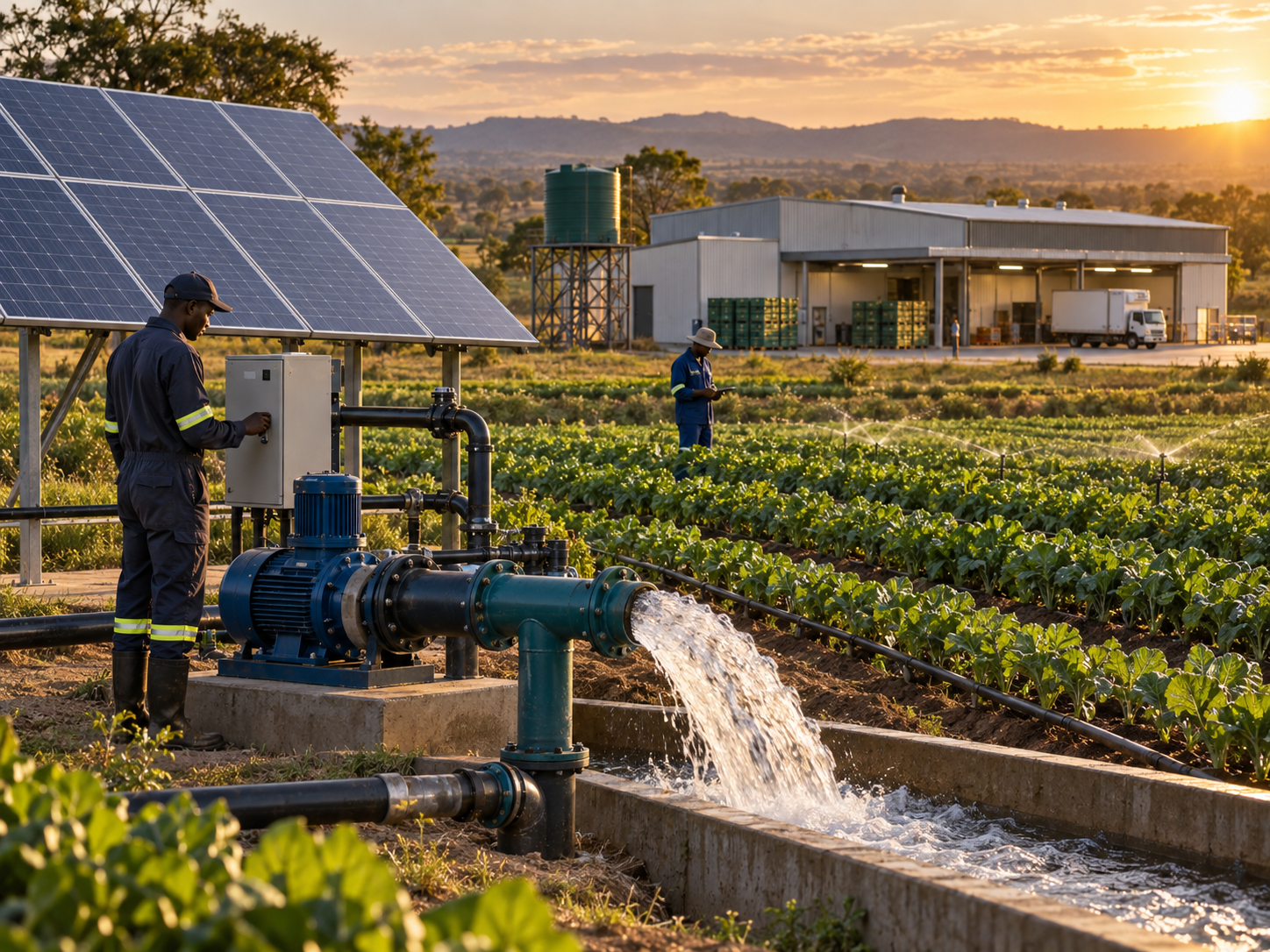
The financing case is strongest where the energy asset is directly linked to a visible source of repayment.
Application
Repayment logic
Suitable structure
Solar irrigation
Additional crop cycles, more reliable output and verified diesel or electricity savings
Equipment finance, lease-to-own or an offtaker-linked facility
Cold storage and milk chilling
Storage fees, protected product value and lower spoilage
Shared-infrastructure vehicle, lease or energy-as-a-service contract
Agro-processing
Processing margin, contracted throughput and avoided downtime
Term loan or embedded-generation agreement supported by sponsor equity
Biogas from agricultural waste
Fuel and heat savings, power value and reduced waste-management cost
Blended finance with technical support where operating history is limited
Source: SwitzView analytical framework based on IRENA, RE4Agri and Zimbabwean financing evidence. Structures remain project-specific.
Solar irrigation can be compelling when water is secure, the crop has a dependable market and the additional production is worth more than the annual financing and operating cost. It is much weaker when repayment relies on optimistic yields, uncontracted commodity prices or a single rain-dependent season.
Cold storage can produce a recurring fee stream, particularly where several farmers or traders use one facility. Yet the lender must test actual throughput. A cold room that is occupied only during a short harvest window may save produce but still fail to generate enough annual revenue for the proposed debt.
Processing projects may be more bankable because the borrower can show sales, power consumption and downtime records. Even then, energy is only one part of the operation. Raw-material supply, customer concentration and working capital can matter as much as the solar system.
Match the financing structure to the user
Established agribusinesses
A farm, processor or exporter with reliable records may use a term loan or lease. Repayment should follow the agricultural cash cycle, with realistic grace periods and seasonal instalments where appropriate. The lender should underwrite the operating business and not assume that equipment resale value will cure weak cash flow.
Smallholders and fragmented demand
Individual debt may be the wrong product. An offtaker, processor or service company can aggregate users, own the asset and charge for pumping hours, cooling space or processing volumes. Pay-per-use and lease-to-own structures reduce the upfront burden, but they shift attention to utilisation, payment collection and operator capability.
Projects that need early risk support
Blended finance can help where the commercial use case is credible but the project lacks a track record or the transaction is too small for conventional funding. Technical assistance, concessional capital, first-loss protection and guarantees can absorb risks that senior lenders are not positioned to take.
REF Zimbabwe shows how this can work. UNCDF reported US$8 million in concessional capital and a further US$8 million committed by Old Mutual, using instruments including concessional loans, blended equity-debt and lease-to-own. The programme had sourced 59 transactions, with eight in due diligence and three approved when the case study was published.
That funnel is revealing. Finance is available, but it does not convert every proposal into an investment. Preparation and credit quality still determine which projects progress.
Repayment design can make or break the project
Agricultural cash flow is seasonal, while many standard loans expect equal monthly payments. A facility for irrigation equipment may therefore perform better when principal repayments follow harvest and sale dates, supported by a reserve for maintenance and weaker seasons. The structure should still test whether the borrower can meet interest and operating expenses between harvests.
Currency requires the same discipline. Imported equipment is commonly priced in US dollars. If the project earns mainly in ZiG, the apparent saving at approval can be eroded by exchange-rate movement before the debt is repaid. A lender may look for USD-linked offtake, matched-currency tariffs, partial equity or a smaller foreign-currency obligation. The answer will depend on the borrower, and a nominally cheaper facility is not necessarily safer if its currency is mismatched.
Project scale also affects the structure. One pump may be too small to justify detailed project finance, while hundreds of unrelated borrowers may be expensive to administer. Standard equipment, remote performance monitoring, common maintenance and collection through a credible aggregator can reduce transaction cost. The aggregator should not merely assemble applications. It should add real credit value through data, servicing, contracts and payment control.
What lenders and investors should test
A renewable-energy proposal for agriculture should answer six commercial questions before the technology is celebrated:
What verified revenue or cost saving will service the financing?
How often will the pump, cold room or processing equipment actually be used?
Do repayments match the harvest and sales cycle?
Are equipment costs, debt and operating revenue in compatible currencies?
Who carries maintenance, performance, insurance and collection risk?
Are water, land, permits, offtake and procurement sufficiently advanced?
These questions convert a renewable-energy concept into a financeable operating plan. They also make it easier to decide which risk belongs with the farmer, technology provider, offtaker, investor, commercial bank or development-finance partner.
The financing case is selective, but credible
Renewable energy can make Zimbabwean agriculture more reliable and productive. Solar irrigation can extend production beyond the rainy season. Cold storage can protect perishable value. Embedded generation can reduce disruption in processing. Biogas can turn waste into an operating resource.
The investment case, however, begins with cash flow. Projects that can prove demand, utilisation, matched-currency repayment and competent operation have a credible route to finance. Projects that rely mainly on market-size estimates or technical promise still need preparation, aggregation or catalytic capital.
Zimbabwe does not need to choose between ambition and discipline. It can pursue both by financing renewable assets around verified agricultural economics. The most useful question is therefore not how much renewable energy agriculture could absorb, but which farms, processors and shared facilities can repay the right capital structure from real operating performance.
Disclaimer
This article is for general information only and does not constitute investment, legal, tax, credit or other professional advice. It is based on information publicly available up to 15 September 2026 at 23:59:59 CAT and may be affected by later developments. Project economics, regulation, currency exposure and financing terms vary. Readers should obtain advice appropriate to their circumstances. Past or indicative performance does not guarantee future results.
Zimbabwe’s first-quarter tourism indicators improved, but the headline 438% investment surge needs careful reading. ZTA says registration of previously informal facilities drove much of the increase. Arrivals and receipts rose, yet national occupancy stayed at 38%. The commercial opportunity is therefore selective: upgrade proven assets, build resilient regional demand and verify that every reported investment is deployable capital.
Zimbabwe’s latest inflation data shows a more stable price environment, while bank lending has also expanded. Yet high nominal and real borrowing costs, the dominance of US dollar credit, cautious bank pricing and limited local-currency transmission still constrain productive finance. This article assesses what must change before stability becomes accessible business credit at scale for Zimbabwean companies.
Zimbabwe’s infrastructure challenge is not only about finding more capital. It is about turning roads, energy, water and digital projects into bankable transactions with credible cash flows, risk allocation and governance. This article examines where funding can realistically come from, why project preparation matters, and what will determine whether announced projects reach financial close and delivery.
Zimbabwean businesses often run short of working capital not because sales are weak, but because cash leaves before customer payments arrive. Structured finance can bridge that timing gap by funding verified receivables, orders, inventory or trade flows. The opportunity is real, but only when legal rights, currency, monitoring and repayment controls are designed around the underlying cash flow.
Zimbabwe’s diaspora inflows are large, but remittances are not the same as investment. The opportunity is to give Zimbabweans abroad credible ways to allocate savings into regulated funds, listed securities, businesses and projects without weakening household support. That requires transparent governance, currency matching, reliable settlement, clear exit routes and investment structures built around real cash flows.
Zimbabwe’s 2026 Mid-Term Budget and Economic Review points to stronger growth, low inflation, firmer foreign-currency inflows and disciplined fiscal execution. For businesses, the signal is improved planning visibility, not the disappearance of risk. Currency matching, tax compliance, energy resilience, working-capital discipline and careful sector selection remain essential as licensing reforms, debt pressures and climate risks shape the second half.