


Let’s be honest about what Zimbabwe’s investment story looks like right now. Not the brochure version. The real one.
At the end of Q1 2026, two sectors carry the economy i.e mining and agriculture. But they are not equal as investment themes. Mining is the clearer near-term hard-currency story. Agriculture is the broader domestic-economy and value-chain story. The best strategies don’t pick one over the other. They pick specific subthemes within each.
Here’s what the numbers actually say.
The big-picture numbers
Zimbabwe’s total merchandise exports hit US$2.775 billion in Q1 2026.1 Gold alone contributed US$1.382 billion, that’s 49.8% of everything the country sold abroad. Tobacco added US$542.3 million (19.5%), and PGMs contributed US$380.6 million (13.7%). Together, those three lines account for about 83% of export earnings.1
The export base is concentrated. That creates strong upside when commodity prices are favorable and amplifies pain when they’re not.
On the production side, Q1 2026 mineral output was led by gold deliveries of 9,894.17 kg, platinum at 3,807.37 kg, palladium at 3,115.61 kg, diamonds at 438,596.88 carats, and chrome at 178,425 metric tons.1 Lithium continues to grow as a production line, though the Q1 2026 tonnage figure from the RBZ tables covers the broader mineral category rather than a standalone lithium line.1
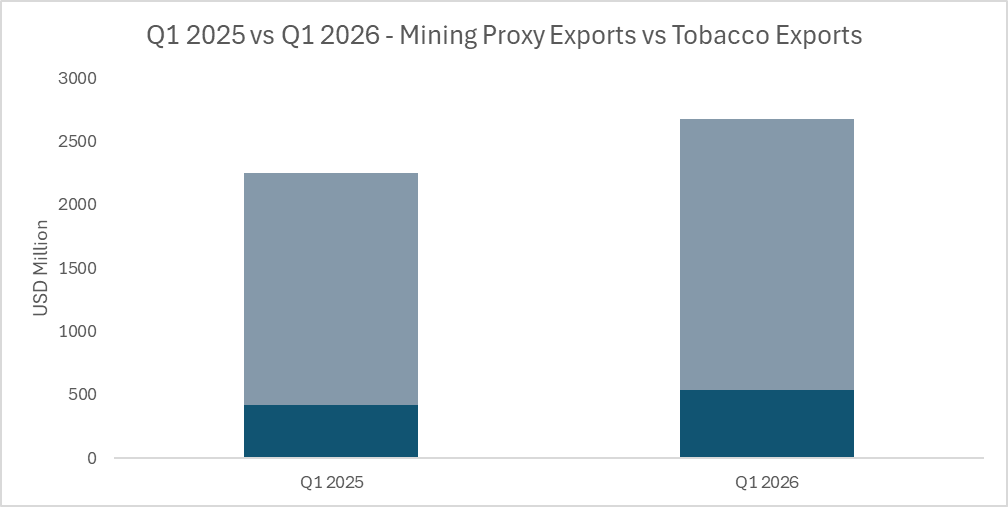
Source: RBZ Quarterly Economic Review, Q1 2025 and Q1 2026 editions.
In agriculture, the 2025/26 season started with expanded planted area. Maize area rose 4.2% to 1,898,528 hectares. Tobacco went up 17.1% to 167,542 hectares. Cotton jumped 26.5% to 154,938 hectares. Soybeans grew 19.6% to 45,048 hectares.1 But a mid-season dry spell from late January to mid-February 2026 caused moisture stress, pulling down harvest expectations.
The most recent full-season hard data comes from ZIMSTAT’s 2024/25 Post-Harvest Survey. Total cereal production was 2,242,937 metric tonnes, including 1,819,819 tonnes of maize.2 Using the 2024/25 maize area, that works out to roughly 1.0 tonne per hectare. By global commercial standards, that is low. And that is precisely why irrigation, seed technology, storage, and logistics matter more than headline crop-area statistics.
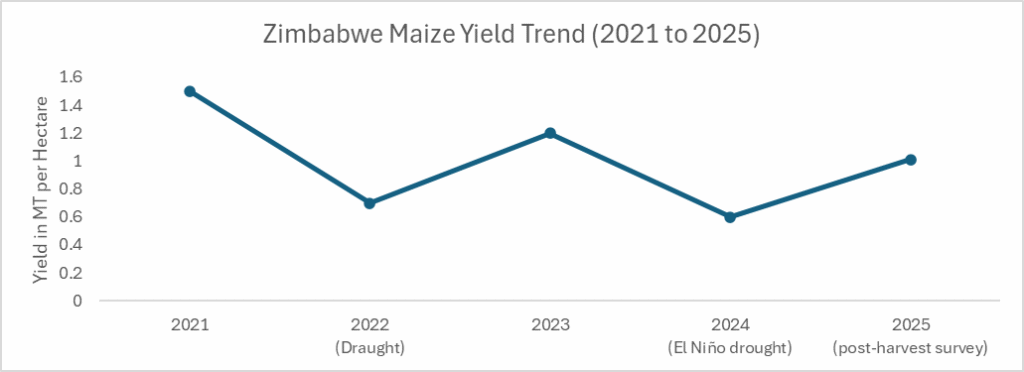
Source: ZIMSTAT Post-Harvest Survey Reports and RBZ quarterly reviews, various years.
Sector Comparison at a Glance
| Metric | Mining | Agriculture |
|---|---|---|
| Share of Q1 2026 exports (lead segment) | Gold: 49.8% of total | Tobacco: 19.5% of total |
| Q1 2026 export value | Mining proxy: ~US$2.133bn1 | Tobacco: US$542.3m1 |
| Key Q1 2026 production volumes | Gold 9,894 kg; Platinum 3,807 kg; Palladium 3,116 kg; Diamonds 438,597 cts; Chrome 178,425 MT1 | 2025/26 area planted: Maize 1,898,528 ha; Tobacco 167,542 ha; Cotton 154,938 ha; Soybeans 45,048 ha1 |
| Latest staple output (official) | N/A | 2024/25 cereal 2,242,937 MT; Maize 1,819,819 MT2 |
| Implied maize yield (2024/25) | N/A | ~1.0 MT/ha2 |
| Main export destinations | UAE 50.5%; China 19.4%; South Africa 19.3%1 | Same national destination mix |
Sources: 1 RBZ Quarterly Economic Review, Q1 2026; 2 ZIMSTAT 2024/25 Post-Harvest Survey.
Macro context – real but fragile
The macro picture improved significantly through 2025 and into early 2026. Annual ZiG inflation fell to 4.38% in March 2026, the lowest sustained inflation under any Zimbabwe-issued currency in over three decades.1 The ZiG appreciated 2.54% during Q1 2026, closing at 25.32 per US dollar.1 The parallel market premium stayed below 20% through the quarter.
The IMF approved a Staff-Monitored Program in April 2026, which is a positive anchor for policy credibility.3 But the SMP is a monitoring arrangement, not a lending program. Zimbabwe still carries unresolved sovereign arrears, a long history of currency regime changes, and a regulatory environment where fiscal and foreign-exchange rules can shift faster than project models assume.
The World Bank estimated that real GDP rebounded strongly in 2025, driven by agriculture, mining, and services.4 The RBZ projects about 5% growth for 2026, led by agriculture (maize and tobacco) and mining (gold).1 But that recovery is partly a rebound from weakness, the 2024 drought and electricity shortfalls hit hard.
The most important Zimbabwe risk is not simple “country risk.” It is rule-change risk. Investors must price the possibility that FX procedures, tax interpretations, royalty mechanics, or value-addition requirements shift faster than project economics can absorb.
Where the real opportunities sit
Mining
Gold is the clearest cash-yield story. Caledonia’s Blanket mine produces around 75,000-80,000 ounces per year and funds the company’s expansion into Bilboes, which, if executed, would add 200,000 ounces per year by 2029.5 The Bilboes feasibility study came in at total capital costs of US$584 million with peak funding of US$484 million.5 These are large numbers for the Zimbabwe context, and they make Bilboes a test case for whether international capital will scale into the country when project economics are strong enough.
PGMs offer deeper reserve life and integrated processing. Zimplats reported revenue of US$641.8 million and profit attributable to shareholders of US$143.7 million for the half year ended December 31, 2025 vs US$350.2 million and US$4.1 million a year earlier.6 Those numbers illustrate both the scale available in Zimbabwean PGMs and how sensitive margins are to metal prices. By March 31, 2026, Zimplats had spent US$360 million on Mupani Mine, US$468 million on smelter expansion and SO₂ abatement, and US$34 million on a 45MW solar project.7
Lithium is the highest-optionality theme but the least mature from a returns-certainty perspective. Reuters reported a US$310 million Build-Operate-Transfer deal at Sandawana in July 2024, and then a US$270 million project framing in January 2025.8 The direction of policy is clear: Zimbabwe wants local processing and has repeatedly signaled a 2027 concentrate export ban.8 That creates upside for processing, power, reagents, and logistics, but it compresses the appeal of simple dig-and-ship models.
Agriculture
Agriculture’s best investment pockets are not raw land plays. They are export niches and enabling infrastructure.
Tobacco is the best-established commercial agriculture export chain. TIMB describes the industry as valued at over US$1 billion, with a well-regulated growing, marketing, and export system.9
Beyond tobacco, the more robust opportunities are:
- Irrigation systems and water management
- Seed and crop-protection distribution
- Storage, aggregation, grading, and cold chain
- Processing (milling, curing, animal feed)
- Export-compliance services
These are less climate-sensitive than open-field farming and can monetize across multiple crop cycles.
Fiscal and regulatory framework
| Item | Mining | Agriculture / Cross-sector |
|---|---|---|
| Corporate income tax | 25% (mining ops); 15% (special mining lease)10 | 25% standard; licensed investor 0% first 5 yrs, then 25%10 |
| Dividend tax (non-resident) | 10% listed; 5% VFEX; 15% other10 | Same |
| Non-residents’ tax on fees | 15%; 10% for licensed investor10 | Same |
| Non-residents’ tax on royalties | 15%10 | Same where applicable |
| Key royalties | Gold 3-5% (price-dependent); Platinum 7%; Lithium 7%; Chrome 5%; Diamonds 15%10 | N/A |
| Additional mineral levy | 1% gross-value on lithium, black granite, dimensional stone10 | N/A |
| FX remittance framework | 100% dividends and disinvestment allowed in principle11 | Same |
| Land ownership (non-resident) | N/A | Constitutional reference to citizens/permanent residents; JV/lease/profit-share supported12 |
Sources: 10 ZIMRA tax rates and Finance Act schedules (updated to Dec 2024); 11 RBZ Foreign Investment and Trade Framework; 12 Veritas Zimbabwe / Constitution of Zimbabwe.
A specific caution on VAT: ZIMRA’s fiscal incentives page states farming inputs and equipment are zero-rated for VAT, but ZIMRA’s VAT mechanics page indicates that 2024 amendments repealed zero-rated items in the Second Schedule and inserted new exemptions. These appear contradictory. Investors should verify the current line-by-line treatment with tax counsel before pricing a project.
Investment recommendations
- Use mining as the anchor theme, agriculture as the optionality theme. Gold and PGMs generate the most visible hard-currency cash flow with listed comparables and published financials. Agriculture works better as a second-leg proposition anchored in processing, inputs, or logistics rather than land-only exposure.
- Prefer value-chain bottlenecks over pure commodity beta in agriculture. Irrigation, warehousing, curing, feed, seed, and cold chain are less climate-sensitive than open-field farming and can monetize across multiple crop cycles.
- Favor projects with existing plants, export channels, and power solutions. Zimplats’ solar and smelter spend, and Caledonia’s use of Blanket cash flow to fund Bilboes, both illustrate how bankable Zimbabwe projects reduce dependency on public infrastructure.
- Treat lithium as a processing and industrial-policy story, not a simple upstream ore story. The local-beneficiation push can create outsized upside, but only if you are comfortable with policy-led value-addition requirements and execution risk.
One-page investor due-diligence checklist
Cash-flow currency
- What share of revenue is earned directly in foreign currency?
- What taxes, royalties, or surrender-like frictions reduce effective FX retention?
- Is dividend or disinvestment remittance dependent on project-specific RBZ approval?
Title and tenure
- Mining: Are all mineral rights, transfers, options, and encumbrances validated? Has special CGT exposure been modeled?
- Agriculture: What is the exact tenure instrument — title deed, 99-year lease, permit, sublease, JV, or management contract? Who can enforce it?
Fiscal stability
- What is the all-in government take (corporate tax + royalty + levies + withholding + transfer taxes)?
- How sensitive is project IRR to a 2-5 percentage point increase in royalty or withholding?
Infrastructure
- Is the project dependent on grid power, self-generation, solar, diesel back-up, or third-party wheeling?
- Are water rights, effluent permits, storage, and road or rail logistics already secured?
Climate and operating resilience
- Agriculture: What is the irrigation ratio, storage position, and input-finance plan?
- Mining: What is the sensitivity to gold, PGM, or lithium price assumptions and to plant downtime?
Community and ESG
- Is there a valid ESIA, community consultation record, grievance process, and labor-risk plan?
- If operating near artisanal miners or smallholder areas, has child-labor, mercury, and conflict-interface risk been assessed?
Counterparties and exits
- Is the investment thesis reliant on a single buyer, policy waiver, or state-linked counterparty?
- What is the realistic exit route: trade sale, dividend stream, refinancing, VFEX/ZSE listing, or long-hold cash yield?
Final take
Zimbabwe is investable, but not on autopilot.
Mining is the stronger theme because it already dominates exports, earns hard currency, and has visible corporate case studies that prove projects can scale.
Agriculture is the more socially important sector and potentially the more transformative one. But it demands sharper structuring and tighter operational control to be equally investable.
The most attractive cross-sector strategy is a barbell: export-generating mining exposure on one side, and agriculture-enabling infrastructure and services on the other.
If you treat Zimbabwe as a policy-sensitive, execution-sensitive, and community-sensitive market, there are still attractive opportunities here. If you underprice those frictions, you will misjudge both timing and risk.
Sources:
- Reserve Bank of Zimbabwe. Quarterly Economic Review: Q1 2026. Available at: rbz.co.zw ↩1 ↩2 ↩3 ↩4 ↩5 ↩6 ↩7 ↩8 ↩9 ↩10 ↩11 ↩12 ↩13 ↩14
- Zimbabwe National Statistics Agency. 2024/25 Post-Harvest Survey Report. September 2025. Available at: zimstat.co.zw ↩1 ↩2 ↩3 ↩4
- International Monetary Fund. IMF Management Approves a Staff-Monitored Program for Zimbabwe. April 16, 2026. ↩1
- World Bank. Zimbabwe Economic Update 2025: Fostering a Business-Enabling Regulatory Environment for Private Sector Growth. November 2025. ↩1
- Reuters. Caledonia to proceed with Bilboes gold project in Zimbabwe. November 25, 2025; Caledonia plans to spend $132 million on Zimbabwe’s biggest gold mine this year. January 14, 2026. ↩1 ↩2
- Zimplats Holdings Limited. Half Year Ended 31 December 2025 — Appendix 4D. February 2026. ↩1
- Zimplats Holdings Limited. Quarterly Report for the Period Ended 31 March 2026. April 2026. ↩1
- Reuters. Zimbabwe’s Kuvimba signs $310 mln lithium mine deal. July 18, 2024; Zimbabwe anticipates lithium prices to justify $270 mln project with China. January 20, 2025. ↩1 ↩2
- Tobacco Industry and Marketing Board. timb.co.zw ↩1
- Zimbabwe Revenue Authority. Tax Rates and Finance Act updated to 1 December 2024. ↩1 ↩2 ↩3 ↩4 ↩5 ↩6 ↩7 ↩8
- Reserve Bank of Zimbabwe. Foreign Investment and Trade Operational Framework. ↩1 ↩2
- Veritas Zimbabwe. Constitution of Zimbabwe (consolidated 2018). ↩1 ↩2
Can Zimbabwe Turn Price Stability into Productive Credit?
Zimbabwe’s latest inflation data shows a more stable price environment, while bank lending has also expanded. Yet high nominal and real borrowing costs, the dominance of US dollar credit, cautious bank pricing and limited local-currency transmission still constrain productive finance. This article assesses what must change before stability becomes accessible business credit at scale for Zimbabwean companies.

Financing Zimbabwe’s Infrastructure Ambition
Zimbabwe’s infrastructure challenge is not only about finding more capital. It is about turning roads, energy, water and digital projects into bankable transactions with credible cash flows, risk allocation and governance. This article examines where funding can realistically come from, why project preparation matters, and what will determine whether announced projects reach financial close and delivery.

Unlocking Working Capital Through Structured Finance in Zimbabwe
Zimbabwean businesses often run short of working capital not because sales are weak, but because cash leaves before customer payments arrive. Structured finance can bridge that timing gap by funding verified receivables, orders, inventory or trade flows. The opportunity is real, but only when legal rights, currency, monitoring and repayment controls are designed around the underlying cash flow.

Turning Diaspora Remittances into Productive Investment in Zimbabwe
Zimbabwe’s diaspora inflows are large, but remittances are not the same as investment. The opportunity is to give Zimbabweans abroad credible ways to allocate savings into regulated funds, listed securities, businesses and projects without weakening household support. That requires transparent governance, currency matching, reliable settlement, clear exit routes and investment structures built around real cash flows.

What Zimbabwe’s 2026 Mid-Year Economic Review Means for Business
Zimbabwe’s 2026 Mid-Term Budget and Economic Review points to stronger growth, low inflation, firmer foreign-currency inflows and disciplined fiscal execution. For businesses, the signal is improved planning visibility, not the disappearance of risk. Currency matching, tax compliance, energy resilience, working-capital discipline and careful sector selection remain essential as licensing reforms, debt pressures and climate risks shape the second half.

How to Evaluate an Investment Opportunity Before Committing Capital
A high promised return is only the starting point. Before committing capital, learn how to evaluate an investment opportunity in Zimbabwe by testing its cash-flow source, legal structure, promoter, expected return, currency exposure, liquidity, security, fees, regulatory standing and exit options, while identifying the risks, assumptions and potential losses that could affect your capital and investment objectives.