

A Zimbabwean food processor choosing its next export market should start with the product, the delivery route and the buyer who can reorder. Our preferred shortlist is biscuits and shelf-stable juices for Zambia and central Mozambique, alongside tomato paste made to buyer specifications for Botswana. These Zimbabwe regional export opportunities warrant targeted commercial trials. The evidence does not yet establish the size of the orders available or which exporter can profitably win them.
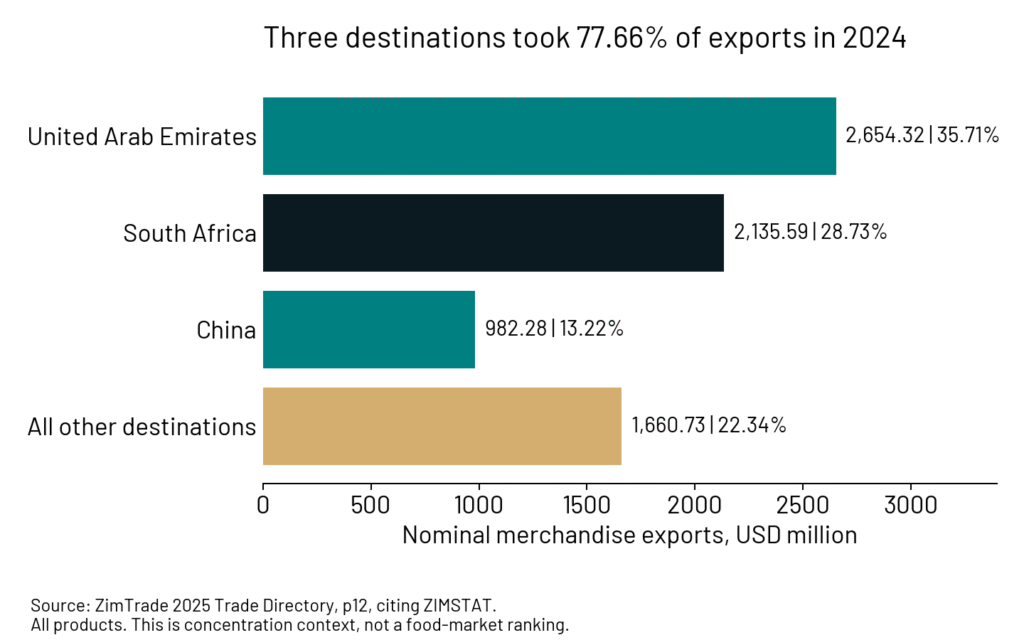
National export figures give only part of the answer. ZimTrade’s 2025 Trade Directory records US$7.43 billion of merchandise exports in 2024. The three largest destinations together accounted for 77.66%, calculated from its underlying values. Those totals include minerals and unmanufactured tobacco. They cannot tell a biscuit maker which distributor needs another supplier. [S1]
Where the product and market fit is strongest
Zambia offers a starting point for a manufacturer already able to supply consistent biscuits or shelf-stable juice. ZimTrade’s July 2024 market intelligence identifies demand in these categories alongside established Zimbabwean production capability. It also identifies South Africa as a major processed-food supplier. That makes Zambia a competitive market with known demand, rather than an empty shelf waiting to be filled. [S2]
The initial proposal should be narrow: one distributor, an agreed delivery territory and a small set of pack sizes. Lusaka can be a proposed test area, but the choice must follow the distributor’s actual coverage and delivered-price comparison. A national exclusive agreement granted before the first reorder could tie up a market without securing useful sales. An exporter should seek evidence of store access, stock movement and collection performance before expanding the territory.
Central Mozambique is a second route to investigate, particularly for a producer positioned to serve Beira or Tete. ZimTrade’s July 2026 market account identifies food and personal-care opportunities from earlier Sofala and Tete engagements. Its older processed-food intelligence specifically identifies biscuits and fruit juices. Together, these sources support a focused route and category investigation; they do not establish current shelf prices or customer commitments. [S2, S5]
The commercial comparison needs to be city specific. A Mutare-based processor and a Bulawayo-based processor will not face the same route economics. Nor should evidence from Beira be treated as proof of demand in Maputo. Obtain a delivered quote to the intended warehouse and agree how the product will reach shops beyond it. Portuguese packaging adaptation and buyer-approved product information should be costed before the first production batch.
Biscuits and juice also behave differently in a truck. A shelf-stable biscuit avoids refrigeration, although breakage and pack protection matter. Ready-to-drink juice carries considerable liquid weight relative to its selling value. A juice producer should compare the margin after transport and distributor charges with the biscuit alternative, rather than assuming that demand makes both equally attractive. A different pack or concentrated format may improve the economics, but only if the buyer accepts it.
| Product | Zambia | Central Mozambique | Botswana |
|---|---|---|---|
| Biscuits | Investigate first | Investigate first | Buyer-led test |
| Shelf-stable juice | Buyer-led test | Buyer-led test | Secondary lead |
| Tomato paste | Secondary lead | Secondary lead | Investigate first |
| Pipes and fittings | Defer | Secondary lead | Defer |
Botswana offers a more specific processing lead
Tomato paste for a Botswana food manufacturer or food-service distributor is a useful third candidate. ZimTrade’s October 2023 account records buyer interest in paste made to specification. That is a concrete lead for value addition, but an old conversation is not an open order today. The case should be refreshed directly with buyers rather than justified by repeating the fresh-produce restrictions described in that historical article. [S3]
USDA’s Botswana Exporter Guide, published on 23 March 2026, identifies processed vegetables and sauces among imported categories and describes a retail environment with strong South African supply links and price-sensitive consumers. Its perspective is that of US exporters, so it is useful market context rather than a Zimbabwe-specific sales forecast. [S4]
A Zimbabwean processor could therefore test an industrial pack before funding a retail brand launch. The buyer’s specification should settle the required solids content, ingredients, packaging, shelf life, batch testing and acceptable delivered price. Retail packs add a separate distribution and promotion question. English labels and importer details also need attention; the importer should verify the exact product requirements with the relevant authorities. [S4]
Consider a hypothetical Zimbabwean processor receiving US$20.00 per case after agreed distributor deductions. Assume production costs of US$12.00, freight and clearance of US$2.00, packaging adaptation and compliance of US$1.00, and expected claims and credit costs of US$0.50. Contribution before fixed overhead and tax is US$4.50 per case. These are illustrative assumptions, not observed market prices or freight quotations.
If revenue falls to US$18.00 and freight rises to US$3.00, that contribution falls to US$1.50. A seemingly modest change consumes two-thirds of the original contribution. Actual duties, taxes and any recoverable charges must be separately confirmed and inserted into the quotation. This is why the first useful evidence is a costed specification and a repeatable delivered order.
Large markets can still be difficult markets
The Democratic Republic of Congo deserves attention, but should follow stronger route and buyer validation for an exporter making its first regional move. ZimTrade reported processed-food sourcing interest from visiting DRC buyers in May 2024. That supports further investigation, not a conclusion that a particular city or importer will pay a viable price. This research did not establish comparable city-specific distribution and transport evidence for DRC. [S7]
South Africa also remains commercially important. Its scale in Zimbabwe’s export totals should not be confused with easy access for another manufactured product. For an individual exporter, an established buyer there may offer a better opportunity than an untested buyer elsewhere. The shortlist is intended to guide prospecting where a company lacks that advantage, not to redirect sound existing business.
Manufacturers outside food should apply the same product specificity. ZimTrade’s Mozambique account identifies pipes and electrical fittings among construction opportunities. An existing qualified supplier with a contractor’s specification may find that lead more attractive than launching a consumer brand. This research has less product-level trade evidence for that route, so it remains a secondary lead rather than a quantified recommendation. [S5]
What should determine the first commercial trial
Our preferred approach is to request distributor proposals for biscuits or shelf-stable juices in Zambia and central Mozambique, and buyer specifications for tomato paste in Botswana. Choose between them using the exporter’s actual plant, route costs and buyer access. A small paid trial should establish whether the product survives delivery, sells at the agreed net price and attracts a reorder without exceptional discounts.
Trade preferences can improve the result where a product qualifies, but regional membership alone does not establish duty-free entry. ZimTrade’s Exporters Guide explains the role of qualifying origin. Obtain classification, origin and import-requirement confirmation for the actual product before promising a landed price. [S6]
The conclusion changes if the buyer cannot provide distribution evidence, the product needs costly adaptation, or the delivered price leaves too little contribution. Regional growth is most defensible where a specific Zimbabwean production capability meets a documented buyer need at a repeatable price. The next market should be chosen case by case, with the first reorder carrying more weight than the size of the national import headline.
Disclaimer
This article provides general information and analysis, not personal investment, legal or tax advice, an offer or an endorsement of a supplier. Past performance does not guarantee future results. Market conditions and regulations may change. Obtain advice appropriate to your circumstances. Information cutoff: 10 November 2026 at 23:59:59 CAT.
Sources and further reading
- S1 | ZimTrade 2025 Trade Directory | 2025-10-31 month-end availability bound
- S2 | ZimTrade Trading Post July 2024 | 2025-03-31 month-end availability bound
- S3 | Botswana has a demand for Zimbabwean products | 2023-10-26
- S4 | USDA Botswana Exporter Guide 2025 BC2026-0001 | 2026-03-23
- S5 | Zim firms eye growth opportunities in Mozambique | 2026-07-03
- S6 | ZimTrade Exporters Guide 2024 | 2024-07-31 month-end availability bound
- S7 | ZimTrade Trading Post June 2024 | 2024-06-30 month-end availability bound

What Zimbabwe’s Factory Output Reveals About Industrial Recovery
Zimbabwe’s factory recovery is uneven. Metals rebounded and food output edged higher, but several subsectors produced less in the first quarter of 2026 than a year earlier. Delta’s later sales volumes show how demand can still stretch capacity at one company. For manufacturers, the expansion case starts with repeat orders and a demonstrable production bottleneck.

Is Zimbabwe’s Digital Infrastructure Ready for Private Capital?
Zimbabwe’s digital infrastructure can attract private capital where paying demand, reliable service and recoverable costs are demonstrable. Rising data traffic supports the opportunity, but does not establish returns. This article examines broadband, data centres, cloud services and secure networks, highlighting affordability, imported costs, currency settlement and the evidence needed to distinguish proposals from operating businesses.

Can Zimbabwe Convert Its US$535 Million Project Pipeline into Investment?
Zimbabwe’s announced US$535 million priority pipeline signals potential financing demand, rather than committed investment. Converting opportunities into transactions requires funded preparation, credible cash flows, currency alignment and suitable capital. This article examines those conditions using official summaries, explains the limits of the available evidence, and identifies what sponsors and investors should monitor as projects progress.

Financing Zimbabwe’s 2026/27 Agricultural Season
Zimbabwe’s 2026/27 agricultural season needs finance that reaches beyond seed and fertiliser. This article examines how input delivery, irrigation, buyer payments, insurance and repayment timing should fit together under an uncertain rainfall outlook, while distinguishing announced facilities from accessible credit and identifying the operating evidence lenders, investors and agribusinesses should monitor before committing seasonal capital.

Where Zimbabwe’s 2027 Budget Could Unlock Private Investment
Zimbabwe’s 2027 budget could attract private investment by improving power, irrigation, logistics, tax predictability and financing conditions. Treasury’s strategy provides a useful direction, but proposed allocations are not completed projects or enacted incentives. This article examines where public resources could support viable private activity and what businesses should verify before relying on promised reforms or funding.

Zimbabwe’s Capital Market Opportunity Beyond Equities
Zimbabwe’s capital markets now extend beyond listed shares into REITs, debt structures, commodity-oriented funds and private vehicles. Yet registration and product availability do not guarantee access or liquidity. The real opportunity lies in instruments with transparent cash flows, credible valuation, currency alignment and practical exits that can meet the needs of institutions and private investors.